Select Spa:
Thai Massage: What It Really Is and Who Actually Needs It
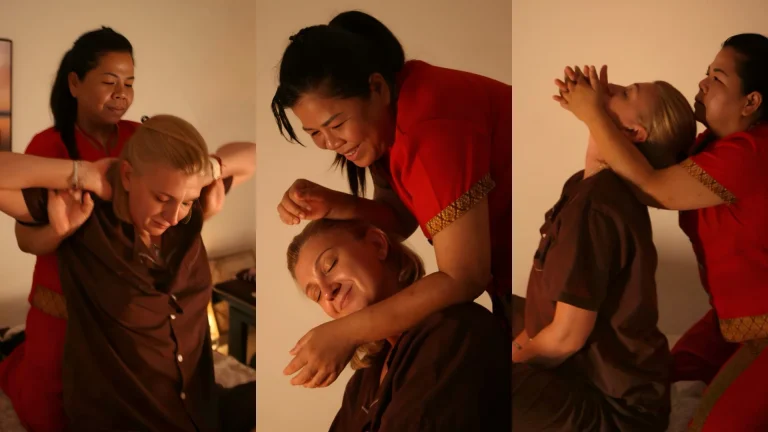
If you’ve ever searched for “Thai massage benefits,” “what is Thai massage,” or “Thai massage Budva,” you’ve probably seen a lot of generic phrases. Now imagine this: you walk into a spa, lie down on a mat, and the therapist starts working on you… with their feet, elbows, and knees. You don’t move — everything is done for you. Sounds strange? That’s exactly how real traditional Thai massage works.
Let’s break down what this method is, why it’s needed, and who it suits.
What is Thai massage and how does it differ from regular massage?
Thai massage is not just muscle kneading. It’s a complete system of bodywork that comes from Eastern medicine, combining practices from Indian Ayurveda and traditional Chinese medicine. Unlike classic European massage, where the therapist works only with hands and mostly on the surface of the body, Thai technique uses elbows, knees, forearms, and even feet. This allows for deep work on muscles, ligaments, and joints.
Another important difference: during Thai massage you don’t undress. You stay in comfortable cotton clothes, lie on a mat, and the therapist performs sequential movements along specific body lines — sen lines, the ten main energy channels. At one moment it feels like stretching, at another like point pressure, at a third like gentle rocking. That’s why Thai massage is often called “passive yoga” or Thai yoga massage: the therapist does all the exercises for you while you simply relax.
Why do people look for Thai massage?
We analyzed the most common questions:
- What is Thai massage?
- What does Thai massage help with?
- Does Thai massage hurt?
- Thai massage benefits and risks
- How long does a session last?
- Is it allowed during pregnancy?
- Where to get Thai massage in Montenegro?
- Thai massage Kotor, Tivat, Budva, Becici
In this article we answer all these questions without the fluff.
What real benefits does it bring to the body?
Thai massage affects not only the muscles but also internal processes. Here’s what happens in the body:
- Tension in the back and neck disappears. Especially relevant for those who work at a computer or spend a long time in one position. Massage helps relieve muscle spasms and reduce pain.
- Blood circulation normalizes. Tissue nutrition improves, and the feeling of cold in the hands and feet goes away.
- Swelling and fluid stagnation decrease. Thanks to work on the lymphatic lines, the body becomes more toned.
- The nervous system relaxes. Studies show that Thai massage lowers stress and anxiety levels. After a session many people notice deeper sleep and reduced anxiety.
- Joint mobility increases. Regular sessions help maintain flexibility even at a mature age.
- Chronic pain decreases. According to research, Thai massage reduces pain in chronic lower back pain, and the effect can last up to 15 weeks.
It’s important to understand: Thai massage is not just “pleasant.” It’s bodywork that requires professionalism. That’s why it’s essential that the therapist understands anatomy and senses the client’s condition.
Does Thai massage hurt? An honest answer
This is one of the most frequent questions. We answer honestly.
Yes, it can be uncomfortable in places. Especially if you have long-standing tension in the body that hasn’t been worked on. When the therapist presses an elbow into tight back muscles or stretches the joints, you may feel tension. But it’s not sharp pain. It’s that “good pain” that tells you the muscle is starting to release.
The therapist always monitors your state. If you feel strong discomfort — say so, and the pressure will be adjusted. The main rule: don’t endure it. The therapeutic effect is achieved through softness and gradualness, not force.
Who should definitely try it?
Thai massage is suitable for almost everyone, but it is especially useful if:
- you feel tired and broken even after sleep;
- your back or neck hurts, especially at the end of the workday;
- you want to recover after a workout or a long walk;
- you experience stress, anxiety, or inner tension;
- you simply want to try something new and deep.
Who is Thai massage contraindicated for?
Like any procedure, Thai massage has limitations. We always recommend consulting the therapist beforehand, but here is the basic list of conditions when massage is not performed:
- acute inflammatory processes and fever;
- exacerbation of chronic diseases;
- first and third trimesters of pregnancy;
- skin diseases in the active phase;
- serious cardiovascular disorders;
- varicose veins, thrombophlebitis, osteoporosis;
- oncological diseases.
If you have any doubts — just call us, we’ll advise you.
How a session goes: step by step
A traditional Thai massage session most often lasts from 60 to 120 minutes. For the first meeting, an hour is usually enough.
What to expect:
- You change into comfortable clothes — provided by the salon.
- You lie on a mat on the floor (not on a massage table).
- The therapist starts with acupressure of the feet — this helps you relax and prepare the body.
- Then the legs, arms, back, shoulders, neck, and head are worked on.
- The final part — gentle stretches and finishing movements.
The whole process feels like a dialogue between the body and the therapist. You feel the tension leaving and the body becoming light.
What happens after the session?
After the massage it’s important to:
- not rush to get up — lie for a few more minutes and let the body adjust;
- drink warm water — this helps eliminate toxins;
- not overload yourself — better to spend the rest of the day at a calm pace.
The next day you may feel pleasant muscle relaxation, and after 1–2 sessions you’ll notice how your overall well-being has changed.
Why choose Kamalaya SPA?
At Kamalaya SPA we have certified therapists from Thailand with many years of experience. We don’t just perform movements — we feel the body and adjust the intensity individually. Our salons are in Tivat, Kotor, Budva, Becici, Bar, Podgorica, and Zlatibor. That means you can always find us nearby.
Thai massage at Kamalaya SPA is not just a procedure. It’s a meeting with yourself in the hands of professionals.
How to book?
You can book a Thai massage by phone, via messengers, or on the website. We’ll help you choose a convenient time and answer all questions.